[an error occurred while processing this directive] [an error occurred while processing this directive] [an error occurred while processing this directive]
[an error occurred while processing this directive]
Metabolism and Biochemistry

OpNAC1 transcription factor regulates the biosynthesis of the anticancer drug camptothecin by targeting loganic acid O-methyltransferase in Ophiorrhiza pumila

Expand
  • 1. Laboratory of Medicinal Plant Biotechnology, School of Pharmaceutical Sciences, Academy of Chinese Medical Science Zhejiang Chinese Medical University Hangzhou 310053 China;
    2. State Key Laboratory of Crop Stress Adaptation and Improvement, Henan Joint International Laboratory for Crop Multi-Omics Research, School of Life Sciences Henan University Kaifeng 475001 China;
    3. Department of Postharvest Science ARO, The Volcani Center HaMaccabim Rd 68, POB 15159 Rishon LeZion 7528809 Israel
    These authors contributed equally to this work
    *Correspondence: Guoyin Kai (kaiguoyin@163.com)

Received date: 2022-08-03

  Accepted date: 2022-09-30

  Online published: 2022-10-04

Abstract
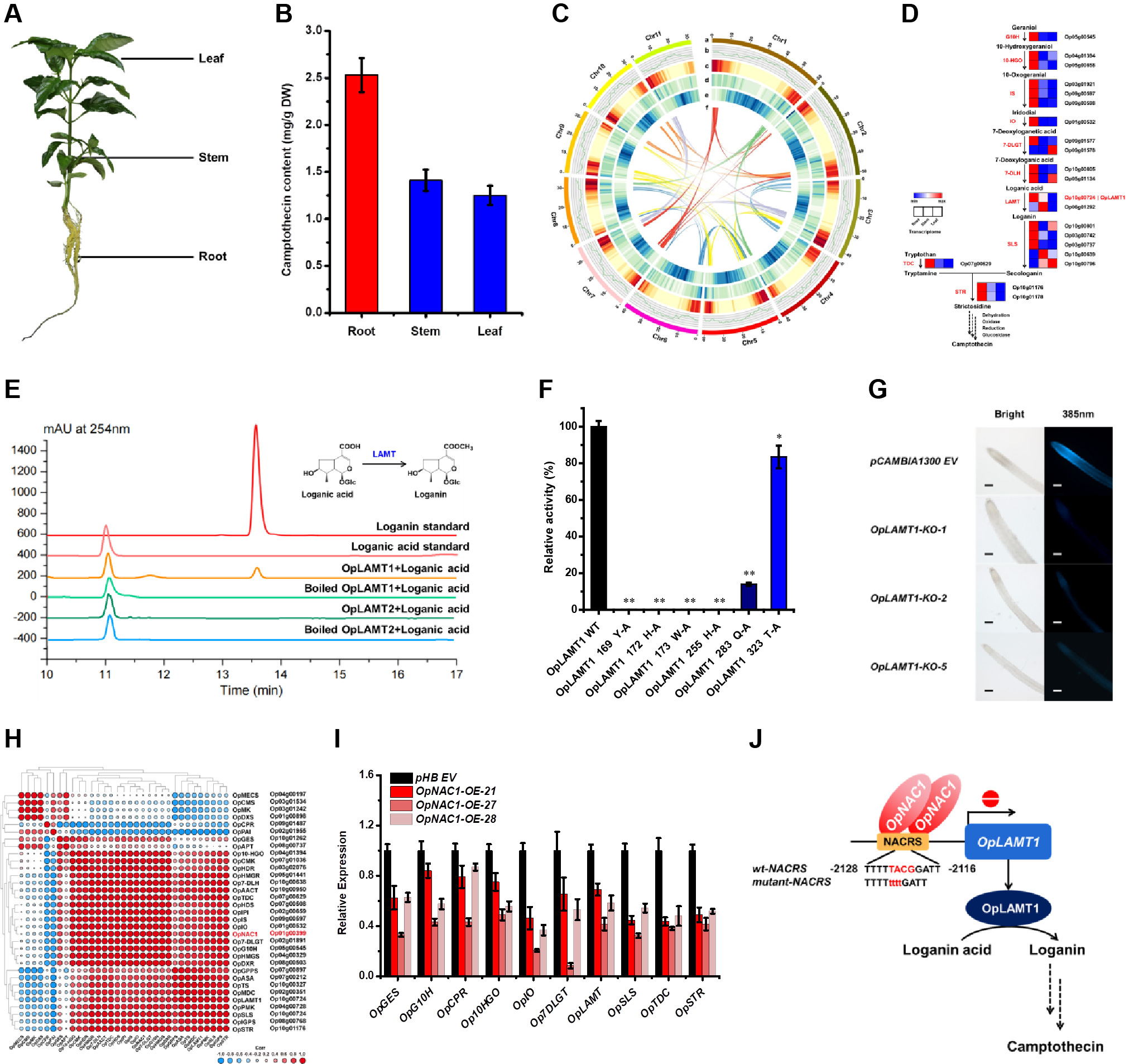
Camptothecin (CPT) is an anticancer pentacyclic quinoline alkaloid widely used to treat cancer patients worldwide. However, the biosynthetic pathway and transcriptional regulation of camptothecin are largely unknown. Ophiorrhiza pumila, the herbaceous plant from the Rubiaceae family, has emerged as a model plant for studying camptothecin biosynthesis and regulation. In this study, a high-quality reference genome of O. pumila with estimated size of ~456.90?Mb was reported, and the accumulation level of camptothecin in roots was higher than that in stems and leaves. Based on its spatial distribution in the plant, we examined gene functions and expression by combining genomics with transcriptomic analysis. Two loganic acid O-methyltransferase (OpLAMTs) were identified in strictosidine-producing plant O. pumila, and enzyme catalysis assays showed that OpLAMT1 and not OpLAMT2 could convert loganic acid into loganin. Further knock-out of OpLAMT1 expression led to the elimination of loganin and camptothecin accumulation in O. pumila hairy roots. Four key residues were identified in OpLAMT1 protein crucial for the catalytic activity of loganic acid to loganin. By co-expression network, we identified a NAC transcription factor, OpNAC1, as a candidate gene for regulating camptothecin biosynthesis. Transgenic hairy roots and biochemical assays demonstrated that OpNAC1 suppressed OpLAMT1 expression. Here, we reported on two camptothecin metabolic engineering strategies paving the road for industrial-scale production of camptothecin in CPT-producing plants.

Cite this article

Xiaolong Hao, Can Wang, Wei Zhou, Qingyan Ruan, Chenhong Xie, Yinkai Yang, Chengyu Xiao, Yan Cai, Jingyi Wang, Yao Wang, Xuebin Zhang, Itay Maoz, Guoyin Kai . OpNAC1 transcription factor regulates the biosynthesis of the anticancer drug camptothecin by targeting loganic acid O-methyltransferase in Ophiorrhiza pumila[J]. Journal of Integrative Plant Biology, 2023 , 65(1) : 133 -149 . DOI: 10.1111/jipb.13377

[an error occurred while processing this directive]
Options
Outlines

/

[an error occurred while processing this directive]