[an error occurred while processing this directive] [an error occurred while processing this directive] [an error occurred while processing this directive]
[an error occurred while processing this directive]
Abiotic Stress Responses

Halotolerant Bacillus sp. strain RA coordinates myo-inositol metabolism to confer salt tolerance to tomato

Expand
  • 1. Shandong Provincial Key Laboratory of Plant Stress, College of Life Sciences, Shandong Normal University, Jinan 250014, China
    2. Dongying Key Laboratory of Salt Tolerance Mechanism and Application of Halophytes, Dongying Institute, Shandong Normal University, No. 2 Kangyang Road, Dongying 257000, China

    These authors contributed equally to this work.

    *Correspondence: Na Sui (suina@sdnu.edu.cn)

Received date: 2024-01-02

  Accepted date: 2024-06-10

  Online published: 2024-07-05

Supported by

This study was supported by the National Natural Science Research Foundation of China (Grant No. 32272040), the National Key R&D Program of China (Grant No. 2022YFD1201702), the Natural Science Foundation Youth Project of Shandong Province (Grant No. ZR2022QC191), the Agricultural Fine Seed Project of Shandong Province (Grant No. 2021LZGC006) and the Special Funds for TaiShan Scholars (Grant No. tsqn202211106).

Abstract
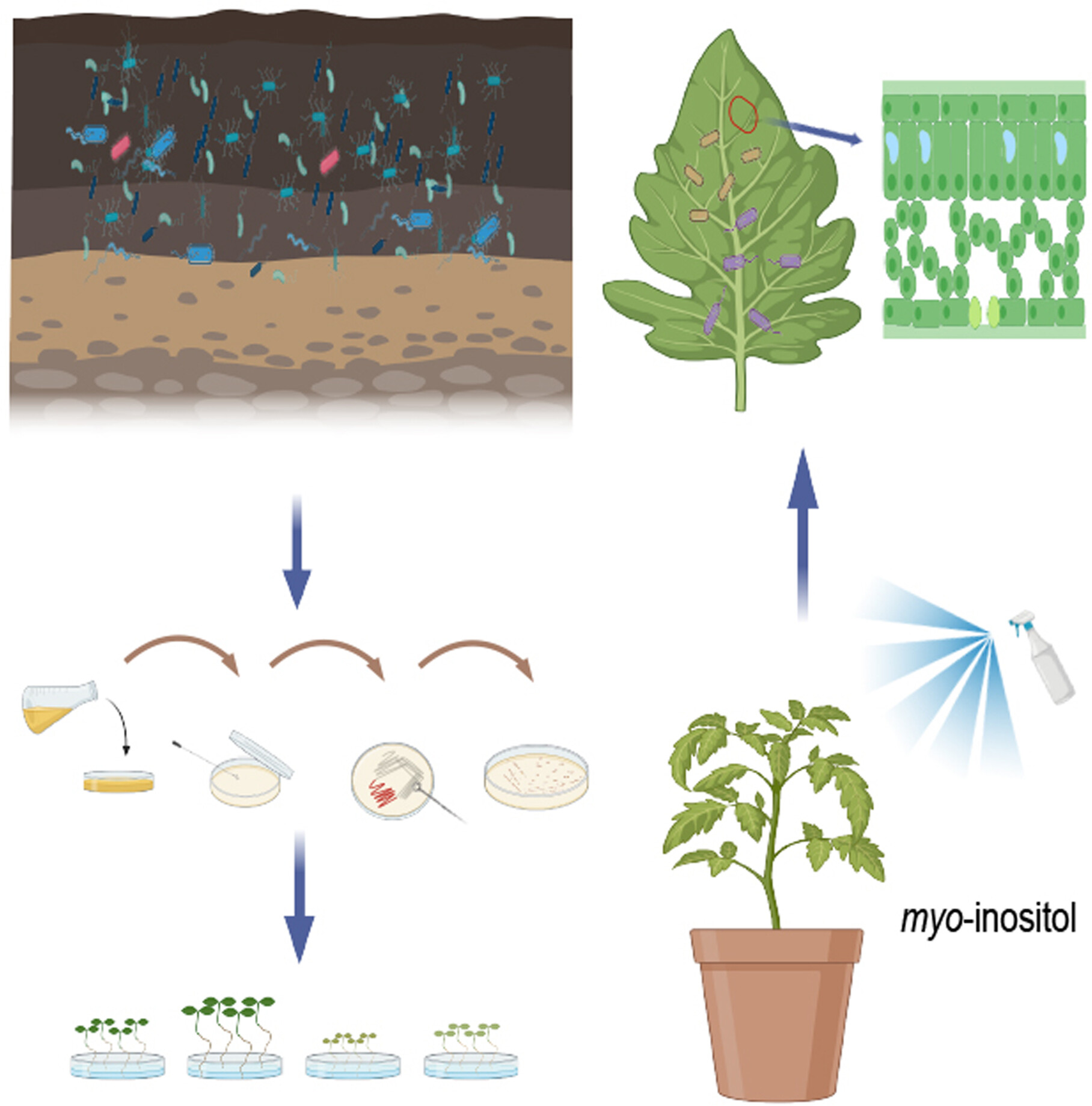
Soil salinity is a worldwide problem threatening crop yields. Some plant growth-promoting rhizobacteria (PGPR) could survive in high salt environment and assist plant adaptation to stress. Nevertheless, the genomic and metabolic features, as well as the regulatory mechanisms promoting salt tolerance in plants by these bacteria remain largely unknown. In the current work, a novel halotolerant PGPR strain, namely, Bacillus sp. strain RA can enhance tomato tolerance to salt stress. Comparative genomic analysis of strain RA with its closely related species indicated a high level of evolutionary plasticity exhibited by strain-specific genes and evolutionary constraints driven by purifying selection, which facilitated its genomic adaptation to salt-affected soils. The transcriptome further showed that strain RA could tolerate salt stress by balancing energy metabolism via the reprogramming of biosynthetic pathways. Plants exude a plethora of metabolites that can strongly influence plant fitness. The accumulation of myo-inositol in leaves under salt stress was observed, leading to the promotion of plant growth triggered by Bacillus sp. strain RA. Importantly, myo-inositol serves as a selective force in the assembly of the phyllosphere microbiome and the recruitment of plant-beneficial species. It promotes destabilizing properties in phyllosphere bacterial co-occurrence networks, but not in fungal networks. Furthermore, interdomain interactions between bacteria and fungi were strengthened by myo-inositol in response to salt stress. This work highlights the genetic adaptation of RA to salt-affected soils and its ability to impact phyllosphere microorganisms through the adjustment of myo-inositol metabolites, thereby imparting enduring resistance against salt stress in tomato.

Cite this article

Fenghui Wu, Zengting Chen, Xiaotong Xu, Xin Xue, Yanling Zhang, Na Sui . Halotolerant Bacillus sp. strain RA coordinates myo-inositol metabolism to confer salt tolerance to tomato[J]. Journal of Integrative Plant Biology, 2024 , 66(9) : 1871 -1885 . DOI: 10.1111/jipb.13733

[an error occurred while processing this directive]
Options
Outlines

/

[an error occurred while processing this directive]