[an error occurred while processing this directive] [an error occurred while processing this directive] [an error occurred while processing this directive]
[an error occurred while processing this directive]
Molecular Physiology

A novel C2H2-type zinc-finger transcription factor, CitZAT4, regulates ethylene-induced orange coloration in Satsuma mandarin flavedo (Citrus unshiu Marc.)

Expand
  • 1. National Key Laboratory for Germplasm Innovation and Utilization of Horticultural Crops, Huazhong Agricultural University, Wuhan 430070, China
    2. National Research Center for Apple Engineering and Technology, Shandong Collaborative Innovation Center of Fruit and Vegetable Quality and Efficient Production, College of Horticulture Science and Engineering, Shandong Agricultural University, Taian 271018, China
    3. Hubei Hongshan Laboratory, Huazhong Agricultural University, Wuhan 430070, China
    *Correspondence: Xiuxin Deng (xxdeng@mail.hzau.edu.cn)

Received date: 2024-04-28

  Accepted date: 2024-08-30

  Online published: 2024-09-25

Supported by

This work was supported by the National Key R&D Program of China (2023YFD2300600), the National Natural Science Foundation of China (No. 31930095) and the National Modern Agricultural (Citrus) Technology Systems of China (No. CARS‐27).

Abstract
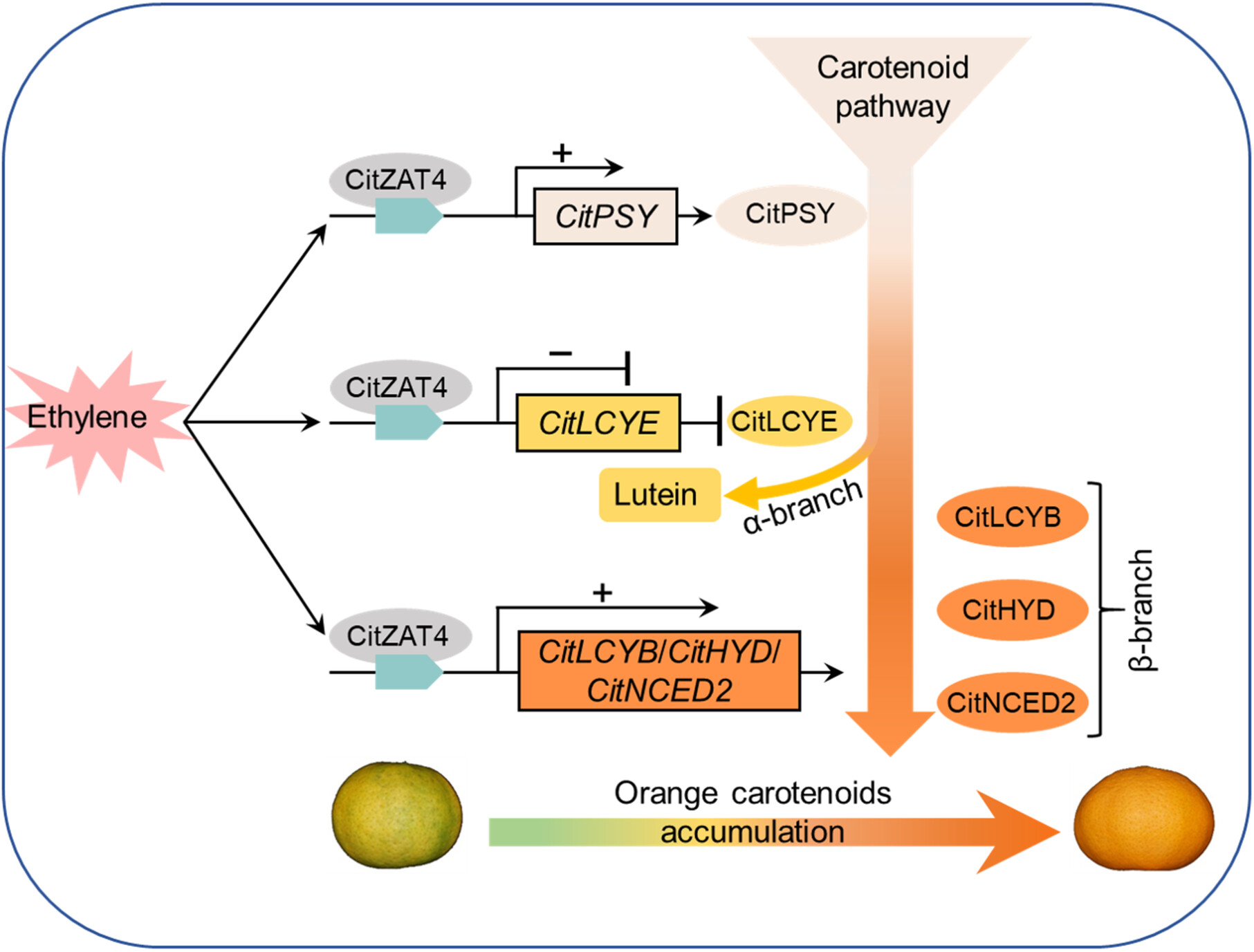
Ethylene treatment promotes orange coloration in the flavedo of Satsuma mandarin (Citrus unshiu Marc.) fruit, but the corresponding regulatory mechanism is still largely unknown. In this study, we identified a C2H2-type zinc-finger transcription factor, CitZAT4, the expression of which was markedly induced by ethylene. CitZAT4 directly binds to the CitPSY promoter and activates its expression, thereby promoting carotenoid biosynthesis. Transient expression in Satsuma mandarin fruit and stable transformation of citrus calli showed that overexpressing of CitZAT4 inhibited CitLCYE expression, thus inhibiting α-branch yellow carotenoid (lutein) biosynthesis. CitZAT4 overexpression also enhanced the transcript levels of CitLCYB, CitHYD, and CitNCED2, promoting β-branch orange carotenoid accumulation. Molecular biochemical assays, including yeast one-hybrid (Y1H), electrophoretic mobility shift (EMSA), chromatin immunoprecipitation quantitative polymerase chain reaction (ChIP-qPCR), and luciferase (LUC) assays, demonstrated that CitZAT4 directly binds to the promoters of its target genes and regulates their expression. An ethylene response factor, CitERF061, which is induced by ethylene signaling, was found to directly bound to the CitZAT4 promoter and induced its expression, thus positively regulating CitZAT4-mediated orange coloration in citrus fruit. Together, our findings reveal that a CitZAT4-mediated transcriptional cascade is driven by ethylene via CitERF061, linking ethylene signaling to carotenoid metabolism in promoting orange coloration in the flavedo of Satsuma mandarin fruit. The molecular regulatory mechanism revealed here represents a significant step toward developing strategies for improving the quality and economic efficiency of citrus crops.

Cite this article

Quan Sun, Zhengchen He, Junli Ye, Ranran Wei, Di Feng, Yingzi Zhang, Lijun Chai, Yunjiang Cheng, Qiang Xu, Xiuxin Deng . A novel C2H2-type zinc-finger transcription factor, CitZAT4, regulates ethylene-induced orange coloration in Satsuma mandarin flavedo (Citrus unshiu Marc.)[J]. Journal of Integrative Plant Biology, 2025 , 67(2) : 294 -310 . DOI: 10.1111/jipb.13778

[an error occurred while processing this directive]
Options
Outlines

/

[an error occurred while processing this directive]