Research Articles

Cryo-EM structure of a minimal reaction center-light-harvesting complex from the phototrophic bacterium Chloroflexus aurantiacus

Expand
  • 1. State Key Laboratory of Membrane Biology, Beijing Advanced Innovation Center for Structural Biology, School of Life Sciences, Tsinghua University, Beijing 100084, China;
    2. Multiscale Research Institute of Complex Systems, Fudan University, Shanghai 200433, China;
    3. School of Biological Science and Technology, University of Jinan, Jinan 250022, China;
    4. School of Chemistry and Life Resources, Renmin University of China, Beijing 100872, China;
    5. School of Life Sciences, Southern University of Science and Technology, Shenzhen 518055, China
These authors contributed equally to this work.

Received date: 2024-06-05

  Accepted date: 2025-01-10

  Online published: 2025-02-06

Supported by

National Natural Science Foundation of China (32270260, 32070267, 32200206, 32241030, and 32271245), the Taishan Scholars Project (tsqn20240516), and the Shandong Provincial Natural Science Foundation, China (ZR2019ZD48 and ZR2020QC057).
Abstract

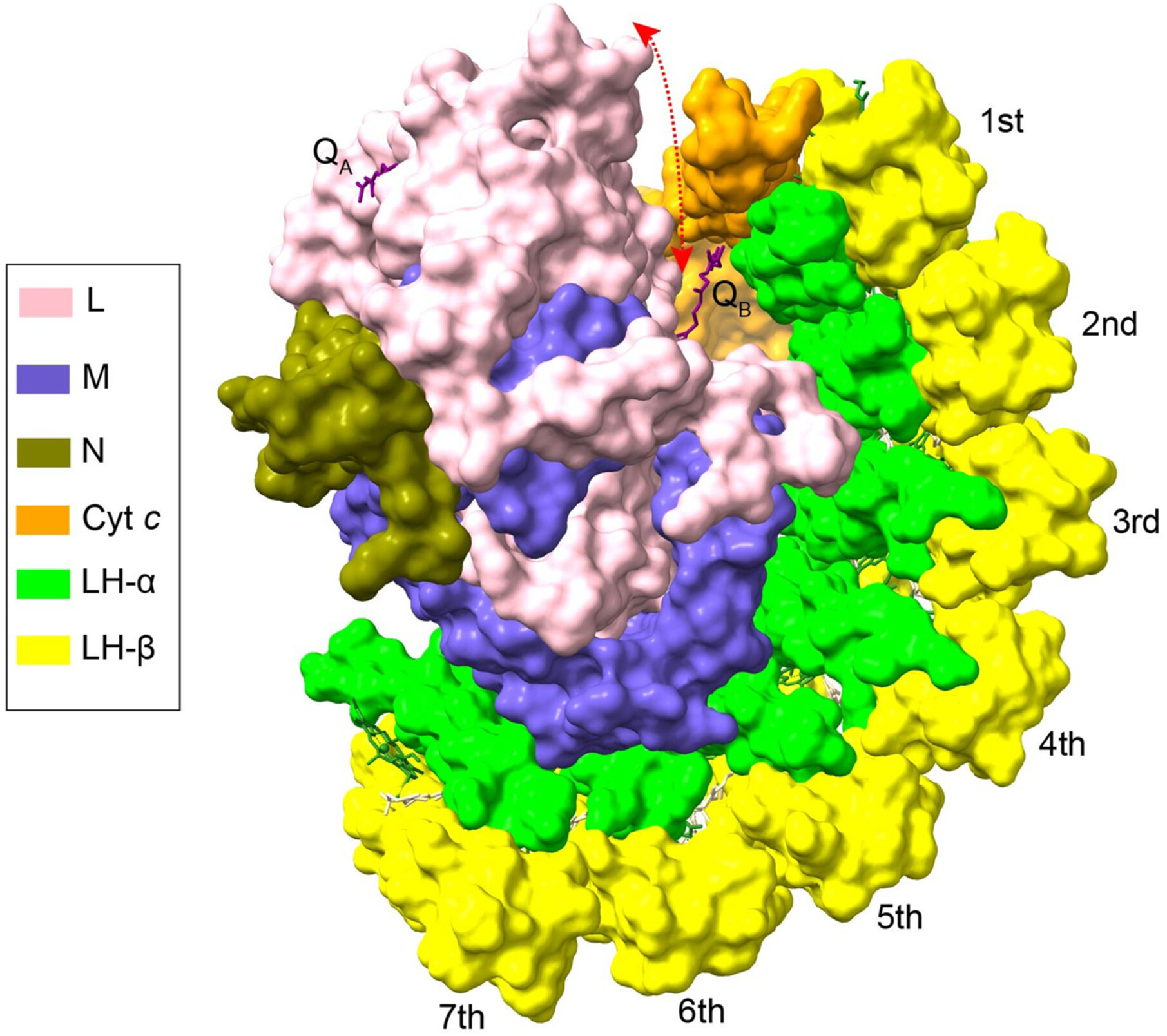
Photosynthetic organisms have developed various light-harvesting antenna systems to capture light and transfer energy to reaction centers (RCs). Simultaneous utilization of the integral membrane light-harvesting antenna (LH complex) and the extrinsic antenna (chlorosomes) makes the phototrophic bacterium Chloroflexus (Cfx.) aurantiacus an ideal model for studying filamentous anoxygenic phototrophs (FAPs). Here, we determined the structure of a minimal RC-LH photocomplex from Cfx. aurantiacus J-10-fl (CaRC-LH) at 3.05-Å resolution. The CaRC-LH binds only to seven LH subunits, which form a crescent-shaped antenna surrounding the movable menaquinone-10 (QB) binding site of CaRC. In this complex with minimal LH units, an extra antenna is required to ensure sufficient light-gathering, providing a clear explanation for the presence of chlorosomes in Cfx. aurantiacus. More importantly, the semicircle of the antenna represents a novel RC-LH assembly pattern. Our structure provides a basis for understanding the existence of chlorosomes in Cfx. aurantiacus and the possible assembly pattern of RC-LH.

Cite this article

Guoqiang Huang, Shishang Dong, Lin Ma, Lin Li, Jinxin Ju, Mei-Jiao Wang, Jian-Ping Zhang, Sen-Fang Sui, Xiaochun Qin . Cryo-EM structure of a minimal reaction center-light-harvesting complex from the phototrophic bacterium Chloroflexus aurantiacus[J]. Journal of Integrative Plant Biology, 2025 , 67(4) : 967 -978 . DOI: 10.1111/jipb.13853

Options
Outlines

/

Editorial Office, Journal of Integrative Plant Biology, Institute of Botany, CAS
No. 20 Nanxincun, Xiangshan, Beijing 100093, China
Tel: +86 10 6283 6133 Fax: +86 10 8259 2636 E-mail: jipb@ibcas.ac.cn
Copyright © 2022 by the Institute of Botany, the Chinese Academy of Sciences
Online ISSN: 1744-7909 Print ISSN: 1672-9072 CN: 11-5067/Q
备案号:京ICP备16067583号-22